Showing posts with label kim rae-won. Show all posts

January 3, 2025

Decibel: Is That a Bomb I Hear?

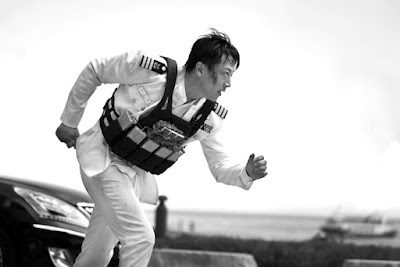
Pure popcorn entertainment, Hwang In-ho's Decibel pits beloved Submarine Commander Kang Do-Young (Kim Rae-won) against former Staff Sergeant Jeong Tae-Ryoung (Cha Eun-woo), a madman planting explosives around town; specifically, bombs triggered by high sound levels meaning the kids at the neighborhood playground, at the public pool, and at the soccer game all need to hush. Good luck with that! As the uniformed Kang scrambles from one potential mass murder to the next, he's assisted by his wife Jang Yu-Jeong (Lee Sang-hee) who happens to be bomb squad brass and CBC reporter Oh Dae-oh (Jung Sang-hoon) who's oddly nonchalant when it comes to protecting his own son. (Happy to report he can take care of himself.)

Some people do get blown up, though. An underwater accident, revealed in flashback, has deaths in store fos us too — albeit of a nobler variety. Per the psychopathic-driven disaster movie genre's preset rules, the crazed mastermind does have a legitimate reason for causing citywide mayhem but his choice of a target feels a little misguided. When you're that filled with that much rage, directing your ire at the right person is often challenging. Inevitably, there's gonna be spill. In this case, there's also going to be debris. And a big news conference at the end where one now-wiser journalist asks,"What did you learn from all this?" As a viewer, feel free to skip that question.

April 14, 2020

The Prison: Who Runs The Law?

Yes, it's preposterous. Yes, it's cynical. Yes, it's horrific. But The Prison is also incredibly, impossibly fun. By taking one penitentiary's inner workings — the guard-inmate sycophancy, the convict hierarchy, the black market trading, the perverted politics — to their most extreme possibility, Na Hyeon's screenplay is a deliriously enjoyable improbability, a twisty-turning political Rube Goldberg machine of crime, cruelty, and power-tripping. The struggle for supremacy between the sadistic old-timer convict Ik-ho (Han Suk-kyu) and the contentious ex-cop newbie Yu-gon (Kim Rae-won) is one of those gloriously gripping, cinematic pissing matches in which who might win remains unknown until the very end.

Is this a movie about corruption? Does it glamorize corruption? Even as it exposes corruption's insidious ubiquity inside South Korea's judicial system? Is it even taking a stance on corruption? Is it, perhaps, some strange adult counterpart to Na's anti-fascist kids cartoon Leafie, A Hen in the Wild? All valid theories, in my humble opinion. In fact, how you interpret this one is definitely up to you. Regardless, I'm guessing that whatever your ideological take, The Prison's final scene is going to make your head spin in that it's one of the most anti-Hollywood endings I can imagine, a bizarre restoration of karmic balance that goes against traditional movie ideas about good and bad and the "ends justify the means" philosophies. Have I got you intrigued yet? Are you thoroughly perplexed and enticed? Good. Now watch the damn movie.

March 27, 2020

Sunflower: Less Fighting Please

Sheesh, this one was a downer. Sunflower is the pitiful tale of a recently released convict whose life spirals further downwards despite his vow of nonviolence moving forward. So while Kang Seok-beom's heartbreaking drama has plenty of ugly fight scenes, the hero (played as a kind of naif by Kim Rae-won) is generally getting beat up without ever striking back. As human punching bags go, he's the thoroughly bruised poster child. So who's he getting pummeled for? His adoptive mother (Kim Hae-sook), his bratty sister (Heo Yi-jae), and his mechanic boss (Lee Ho-sung)... Truthfully, you feel like he'd take a broken nose for anyone.

And so many people want to slug him: His cowardly childhood buddy (Han Jeong-su), the town's sickeningly evil mobster (Kim Byeong-ok), various thugs with various weapons, various high school students with various haircuts. Plus the world's laziest cop. Speaking of which, Sunflower may have one of the most unflattering portraits of the Korean police force committed to celluloid. The duo of officers who patrol this neighborhood are repeatedly witnesses to violence which they watch without ever lifting a hand to help. Their only concern seems to be to get some more food. When the final confrontation between the Job-like, beautifully-tattooed ex-con and the town's gang of lowlifes takes place, the only ones who escape his rage are the despicable boys in blue. Is this a form of social commentary?

February 15, 2015

Insadong Scandal: Beyond the Bechdel Test

The art-forgery caper Insadong Scandal definitely doesn't pass the Bechdel test. Not only are there no conversations between two women that don't have to do with men. There aren't any conversations between two women at all. But the movie does have three fun female characters — a ruthless gallerist (Eom Jeong-hwa), an unrelenting police detective (Hong Soo-hyun) and a leather-clad gangster (Choi Song-hyeon) — that in another movie, would easily have been cast as men. For that I thank writer-director Park Hee-kon. He's at least creating strong roles for women. I'm less appreciative of his writing for men and his casting of the actors who play them.

As the duplicitous master restorer who turns everyone's life upside down, Kim Rae-won looks like he's modeling clothes when he's supposedly copying famous paintings. He's the type of performer who feels most natural when he's singing karaoke and who's most likable when he's getting slugged. Jeong Jin plays an auctioneer with a perm that looks like a joke that can't get a single laugh. As to journeyman actors Kim Byung-ok and Kim Jeong-tae — as sidekicks of good and evil — they're both on automatic pilot. You can bet they spent their time in their trailers reading scripts for other projects with more lines and less cliches. The best of the guys is probably Lim Ha-ryong, a bad-guy-turned-good who has a long monologue on the art of forgery that is definitely the most educational part of the movie.

Not that you'll leave Insadong Scandal truly informed about anything. The one thing I learned after viewing the movie is that Insadong is actually the gallery district of Seoul — the Soho of yore, the Chelsea of now. It in no way felt like a modern day Williamsburg. Eom's high-end wardrobe is a Fashion Week runway of clingy pleasures and there's not a single hipster in sight.

June 26, 2008

My Little Bride: Sixteen Going on Ten


What does it take to get a bratty, egotistical teenager (Mun Geun-young) to realize that the man her grandfather has tricked her into marrying happens to be the cutest, sweetest, most loyal guy this side of the 38th parallel? Evidently, enough evidence to solve all the mysteries of Agatha Christie and Ellery Queen combined. This guy (Kim Rae-won) never demands sex, lets her tell the neighbors he's gay, goes on his honeymoon alone, doesn't try to kiss her, lets her date a swoony guy on the high school baseball team, stays up until all hours of the night to finish her art project without her knowing it, and won't let a soul criticize his little woman along the way. Clearly, a virgin wife is prized by this man. I guess he figures that he's going to get a satisfying payoff in the end. That she's a fairly unlikable young lady with little charm and prone to make ugly faces makes his patience with her misbehavior a strain to credulity. It also gives this romantic comedy a schizoid edge that prevents it from ever feeling like treacle. An effective comic turn from Ahn Sun-yeong as the lecherous spinster who teaches the class where the groom serves his internship brings some legit laughter to My Little Bride. Odd but not bad.